Speckle-tracking EchoCG (strain - EchoCG)
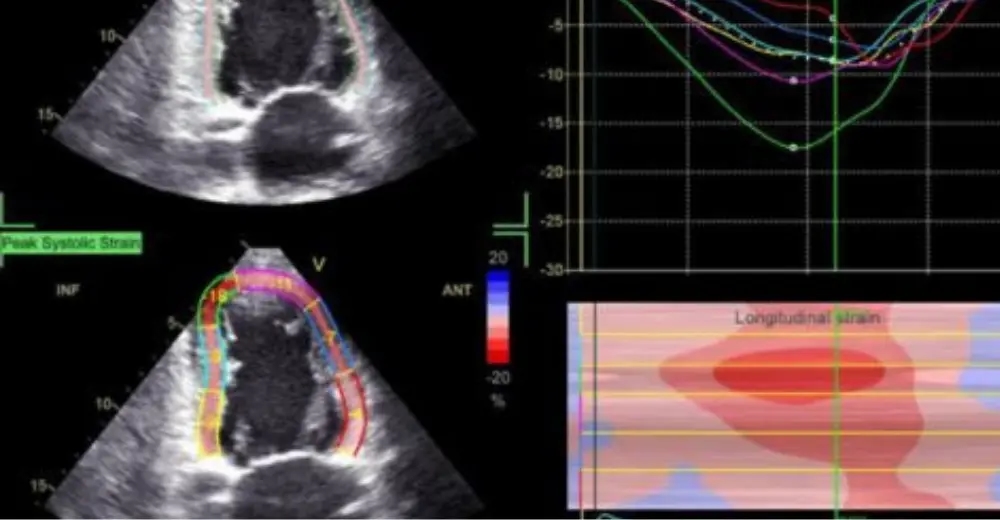
🤔What is the principle of the speckle-tracking EchoCG (strain-EchoCG) technique?
This is a modern echocardiography (EchoCG) technique based on the analysis of the movement of speckles (acoustic points or spots) obtained in 2D (two-dimensional) mode. Most often, the deformation (strain) of the myocardium is assessed in three planes: longitudinal (longitudinal), radial (radial) and circular (circumflex).
❓What allows you to assess strain-EchoCG?
The technique allows you to quantitatively and objectively assess global and segmental myocardial contractility, as well as diastolic function.
🫀For which heart chambers can this technique be used?
Speckle-tracking of the left ventricle is most widely used in clinical practice. Although experience is actively accumulating and research is being conducted on speckle tracking of the left atrium and right heart sections.
🔝What is the advantage of strain echocardiography over left ventricular ejection fraction (EF) assessment?
Ejection fraction reflects global mechanical function, which can be compensated for a long time by areas of the myocardium that contract normally. Strain echocardiography can detect changes when EF is still normal. Its advantage is in the early preclinical detection of contractility changes.
✅ In which nosologies is strain echocardiography informative?
The latest guidelines (ASE, 2018) recommend speckle tracking for a wide range of cardiac pathologies: coronary artery disease, valvular heart disease, heart failure, hypertension, storage diseases, “athletic” heart, for the assessment of cardio- and radiotoxicity, after implantation of an artificial pacemaker, etc.
❌ What are the limitations of the technique? Is it possible to use it for every patient?
The specificity and sensitivity of the technique decreases with tachycardia (heart rate more than 120 beats / min.), irregular rhythm (primarily, with atrial fibrillation). Good visualization is also very important (speckle tracking is problematic for patients with excess weight, pulmonary emphysema, breast implants, impaired mobility of the spine and ribs).
📈 How is the result presented?
The most commonly assessed global longitudinal strain (GLS) of the left ventricle. The mathematically processed result is presented in the form of a 16- or 17-segment diagram (bull's eye), graphs and GLS values obtained from three different slices (LAX, A2Ch, A4 Ch) and the average GLS value
In addition to constructing a standard diagram at rest, it is possible to perform a study during exercise and construct diagrams in dynamics (modified stress echocardiography mode using STRAIN).
Contact us
For quick appointment booking, you can use our bots on Telegram or Viber, or contact us directly by phone or email.