In modern family medicine, cholesterol is no longer just a simplified division into “good” and “bad.” If you aim to consciously take care of your health and rely on evidence-based medicine, it is important to understand that lipid metabolism is a complex system, and its imbalance is a major risk factor for atherosclerotic cardiovascular diseases (ASCVD), including myocardial infarction and ischemic stroke.
How Managing Cholesterol Actually Saves Lives
Let’s examine what modern international guidelines say about this, how risks are assessed, what the target goals of therapy are, and how much relative and absolute risk is reduced for those who change their lifestyle and take medication.
Anatomy of the Lipid Panel: What Is Important to Know About Therapy Targets?
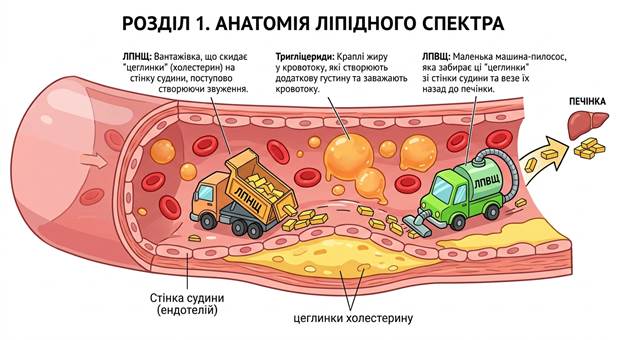
A standard lipid profile includes total cholesterol, low-density lipoproteins (LDL), high-density lipoproteins (HDL), and triglycerides.
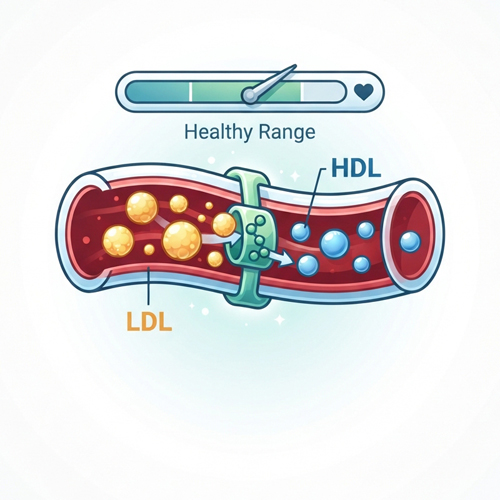
LDL (“bad” cholesterol): This is the main “building block” of atherosclerotic plaques. Modern medicine views lowering LDL as the primary goal of treatment, as clinical studies clearly show: the lower the LDL level, the lower the risk of cardiovascular complications.
Non-HDL cholesterol: Calculated simply: total cholesterol minus HDL. It covers all atherogenic lipoproteins and serves as an excellent additional benchmark.
Triglycerides: Excess triglycerides also correlate with ASCVD risk, while critically high levels (over 10 mmol/L) pose a direct threat of developing acute pancreatitis.
HDL (“good” cholesterol): High levels are usually associated with a lower risk. However, current data indicate that artificially raising HDL with medication does not by itself reduce risk.
Additional markers: In complex or borderline cases, a doctor may order a test for lipoprotein(a) [Lp(a)] or apolipoprotein B (ApoB) for a more accurate assessment of personal risk.
Who Needs Active Therapy and When?
The decision to start lipid-lowering therapy is always made individually. It is based on lipid profile analysis, the presence of comorbidities, and overall risk calculation.
A. Patients with Clinically Confirmed ASCVD
This includes people who have had a myocardial infarction, a coronary intervention (stenting or coronary artery bypass grafting), an ischemic stroke, or a transient ischemic attack (TIA), as well as those with symptomatic peripheral artery disease.
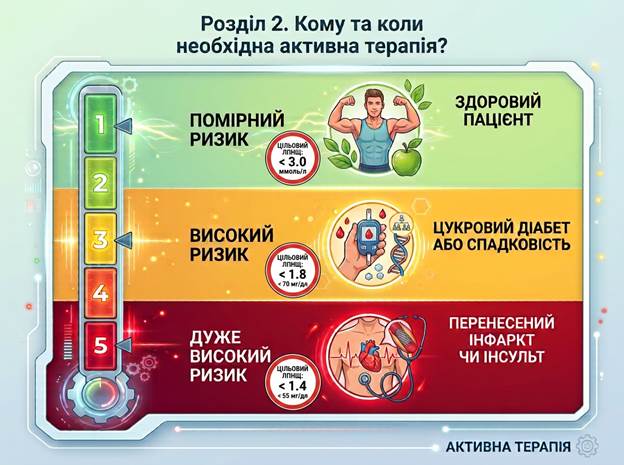
Target levels: For this group, LDL needs to be lowered below 1.8 mmol/L, and for very high risk — even below 1.4 mmol/L. Studies prove that when such values are reached, atherosclerotic plaques can even shrink in volume!
B. Subclinical Atherosclerosis and Primary Prevention
If there are no clinical manifestations of ASCVD yet, risk is assessed using clinical calculators (taking into account age, sex, smoking, blood pressure, and comorbidities).
If the baseline LDL level is 4.9 mmol/L, the patient automatically falls into the very high-risk category and requires drug treatment regardless of other scores.
To clarify risk in borderline cases, coronary artery calcium scoring (CAC-score) via CT is used.
C. Special Clinical Groups
Diabetes mellitus (type 1 and type 2): Due to high cardiovascular risk, most adults with diabetes are recommended moderate- or high-intensity statins regardless of their initial LDL level.
Familial hypercholesterolemia: Genetically determined very high LDL levels (> 4.9 mmol/L) with early vascular problems in the family require early initiation of therapy (sometimes starting in adolescence) to prevent premature coronary heart disease.
Hypertriglyceridemia: Requires lifestyle modification and limiting refined carbohydrates and alcohol. In cases of high risk and residual abnormalities after statins, fibrates or high-dose purified omega-3 fatty acids are used.
Real-World Effectiveness: How Much Does the Risk of Vascular Events Decrease?
In medicine, a distinction is made between relative risk reduction (by what % the threat decreases compared to the baseline state) and absolute risk reduction (by how many actual percentage points the probability of a heart attack or stroke decreases over a given period, such as 5–10 years).
Depending on a person’s baseline risk (primary or secondary prevention), the absolute numbers vary:
Lifestyle modification (diet + physical activity):
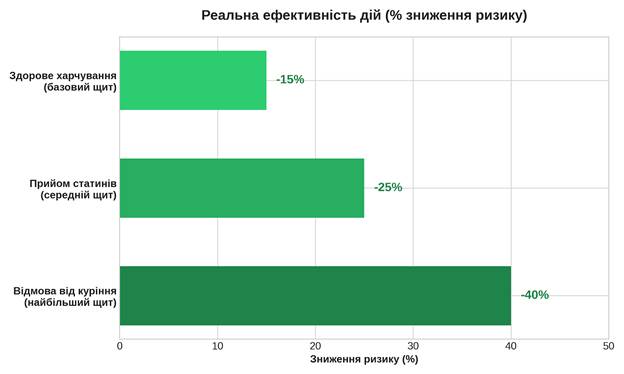
Relative risk reduction: Dietary changes (for example, switching to a Mediterranean diet) and daily aerobic exercise reduce the risk of cardiovascular events by approximately 15–30%.
Absolute risk reduction (over 5–10 years): In people at moderate risk, the absolute probability of a cardiovascular event decreases by 1–3% (for example, from 10% to 7–8%).
Smoking cessation (the single most powerful step):
Relative risk reduction: Complete tobacco cessation reduces the relative risk of recurrent myocardial infarction or cardiovascular mortality by approximately 35–50% (quitting tobacco is more effective than any monotherapy!).
Absolute risk reduction (over 5 years): For people who already have heart disease (secondary prevention), the absolute risk reduction is from 5% to 10% or more (for example, the risk of a major event drops from 20% to 10–12%). In primary prevention, the absolute benefit is about 2–5%.
Taking statins:
Relative risk reduction: Every 1 mmol/L reduction in LDL with statins decreases the relative risk of major vascular events (heart attack, stroke) by 21–25%.
Absolute risk reduction (over 5 years):
Primary prevention (people with no history of vascular disease): absolute risk reduction is approximately 1.5–3% (for example, risk drops from 8% to 5–6%).
Secondary prevention (after a heart attack/stroke or stenting): the absolute benefit is significantly higher at 4–8% or more (for example, from 18% to 10–12%), because the baseline risk in these patients is initially higher.
Lipid control is not a short course “for prevention,” but a long-term and conscious process. Quitting smoking and eating a proper diet lay a strong foundation, while statins add powerful extra protection when lifestyle changes alone are not enough. If you simply stop therapy, atherogenic markers will inevitably return, and with them — cardiovascular risk.
If you want to understand your test results or calculate your individual risk using modern scales, come for a consultation with a family doctor at our clinic — together we will create a clear and effective action plan!
The Arsenal of Modern Treatment: From Lifestyle to Innovations
1. Lifestyle Modification
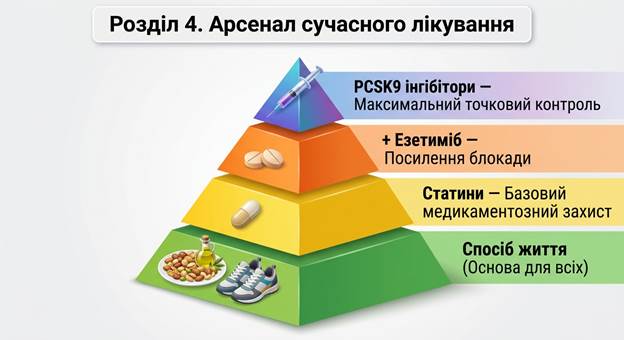
This is the basic foundation for everyone: a Mediterranean or plant-based diet with minimal saturated fats, weight loss, and regular aerobic and strength training. The effect is evaluated after 6–12 months, but in high-risk cases, drug treatment is started in parallel without waiting.
2. Pharmacotherapy
Statins (atorvastatin, rosuvastatin, etc.): The first-line “gold standard.” They inhibit cholesterol synthesis in the liver and speed up LDL clearance, lowering it by 25–55%. Statins also have pleiotropic effects (reducing inflammation in vessel walls). Potential risks (muscle pain, a slight risk of increased blood sugar) are outweighed by the benefits of cardioprotection (a benefit-to-risk ratio of approximately 4:1).
Ezetimibe: Blocks cholesterol absorption in the intestine. Lowers LDL by 20–25%, is well tolerated, and is often added to statins or prescribed on its own if statins are not tolerated.
PCSK9 inhibitors (alirocumab, evolocumab, inclisiran): Innovative biologics (monoclonal antibodies or siRNA) administered subcutaneously (from once every 2–4 weeks to once every 6 months). They provide a strong additional reduction in LDL and are prescribed to high-risk patients when maximum doses of statins are insufficient or not tolerated.
Bempedoic acid: Blocks cholesterol synthesis at another step in the enzymatic pathway (ACL inhibitor) and works well in combination with ezetimibe.
Omega-3 fatty acids (highly purified EPA at 4 g/day): Prescribed for clear indications in hypertriglyceridemia and high ASCVD risk in addition to statins.
What About “Folk” and Alternative Methods?
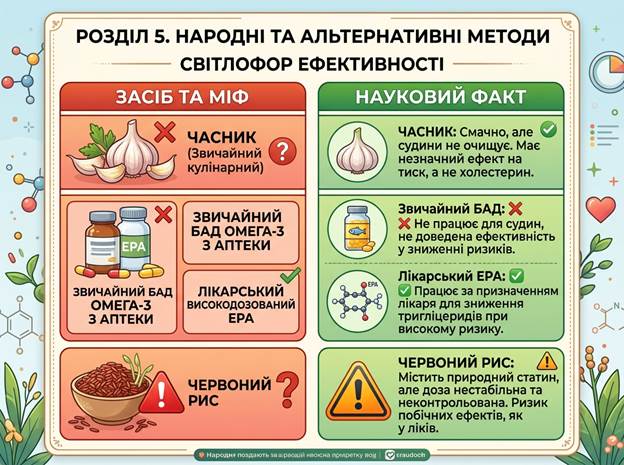
Patients often ask about garlic, red yeast rice, or regular fish oil. What does evidence-based medicine say about this?
Garlic, herbal medicine, homemade infusions: Clinical studies have shown no consistent and clinically significant reduction in LDL or effect on long-term heart attack risk. If there is any relative cholesterol reduction, it is within 2–4%, which does not protect blood vessels when there is a real risk.
Pharmacy fish oil / Supermarket Omega-3: Routine dietary supplements with low concentrations and undefined amounts of active acids (EPA/DHA) have not been proven to prevent cardiovascular catastrophes. In cardiology, only pharmacological doses (4 g/day) of highly purified eicosapentaenoic acid ethyl ester (EPA) are used.
Red yeast rice: Contains a natural substance called monacolin K (a structural analog of lovastatin). It can indeed lower LDL, but due to the lack of dose standardization in supplements, the risk of impurities, and side effects similar to statins (without proper purification control), international guidelines do not recommend replacing proven and safe lipid-lowering medications with it.
Author: Alexander Stanislavovich Nenashev
General practitioner, endocrinologist.